Good work shouldn't metabolise people.

Home Truths is a confidential questionnaire about what actually happens at work. It looks for patterns across what your people have seen and gives you somewhere specific to start looking.

You get a report that shows what's worth investigating, how it might be happening, and what's still unclear.
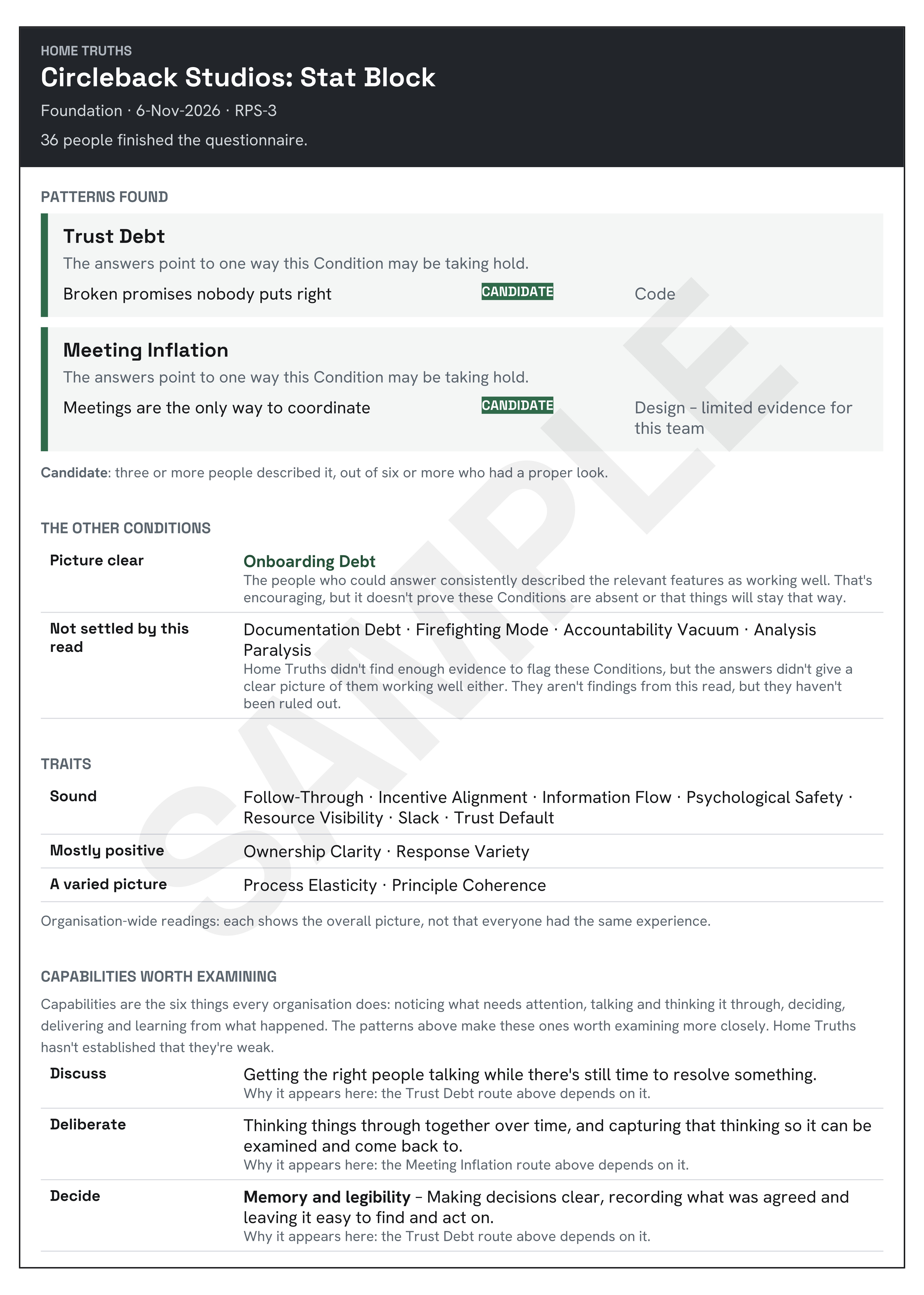
A Home Truths report opens up with a Stat Block - a high-level summary of what it found. Click the pic to see the full thing.

The build meeting has a sequel.

Production add a morning call to find out what's working in the latest build. It lands in the slot QA use to test the latest build. QA bring yesterday's answers, so everyone comes back at four for today's.

By the end of the week, both calls are daily.

That's Meeting Inflation in action. Home Truths looks for signs that keeping everyone up to speed is eating the time people need to actually get the work done.

Give it to Mel.

Mel's the one who gets the hard ones. Her numbers are the best on the team, and her one-to-ones are all thumbs up.

In April she hands in her notice. Her manager is stunned, and passes all her work to the next most reliable person. Clock starts ticking.

That's Hidden Burnout in action. Home Truths looks for signs that the work is getting done at a cost nobody's counting.

When things calm down.

Every month-end, finance stays late making four spreadsheets agree. The fix has been on the to-do list since spring.

"We'll sort it when things calm down," says everyone, reasonably. Things are due to calm down after month-end.

That's Firefighting Mode in action. Home Truths looks for signs that urgent work keeps crowding out the work that would make it less urgent.

Have a word with Claire.

Femi's proposal is due at next month's board. A colleague suggests he mention it to Claire over coffee first.

He does, and it sails through at the meeting. Next time, he skips the meeting entirely, and goes straight to Claire. So does everyone else. The board still meets every month.

That's Politics in action. Home Truths looks for signs that the real decisions are being made somewhere other than where the organisation says they are.

What's the catch?

Management announce a new bonus scheme in a cheerful email. Within ten minutes, the group chat is asking what the catch is.

Last time there was one. This time there isn't, but nobody's taking any chances.

That's Trust Debt in action. Home Truths looks for signs that good faith has run low, and even good news is being read as spin.

It was on our channel.

Marketing launch a half-price weekend. The warehouse finds out from the first customer who rings to ask where their order is.

"Nobody told us," says the warehouse. "It was on our channel in Slack," says marketing.

That's Silo Formation in action. Home Truths looks for signs that teams have drifted far enough apart that work crossing between them keeps getting lost on the way.

We did raise that.

At her first team meeting, the new starter asks why expenses still need a paper form. The room goes quiet in a fond sort of way.

"We've asked the same question," someone says. "A few times." By her third meeting, she's stopped asking too.

That's Learned Helplessness in action. Home Truths looks for signs that people have stopped raising problems they can describe perfectly well.

Quicker than showing anyone.

Whenever the rota spreadsheet breaks, someone says, "Ask Dev." Dev fixes it in ten minutes, which is quicker than showing anyone else how to do it.

Five years on, it's still quicker.

That's Hero Dependency in action. Home Truths looks for signs that normal work leans on a few people the organisation can't do without.

Toner low.

The office printer has said 'Toner low' since June. Everyone assumes facilities know.

Facilities assume IT are sorting it. IT assume it's covered by the lease. Someone's taped a note to the front: "Toner low."

That's Accountability Vacuum in action. Home Truths looks for signs that problems everyone can see are sitting with nobody in particular.

Once the queue's down.

Every question with a number in it goes to the data team, who have a six-week queue. Someone asks if they could learn to pull the reports themselves.

"Love to show you," says the data team, "once the queue's down." The queue is never down.

That's Competence Concentration in action. Home Truths looks for signs that a whole area of know-how is stuck in one corner of the organisation, and everyone else has stopped trying to reach it.

Aisha says six.

Asked how long the new system will take, Aisha says nine months. The director looks disappointed. Someone else says six, and gets the project.

Winds up taking eleven. Next time, Aisha says six.

That's Commitment Inflation in action. Home Truths looks for signs that promises are being made to win the room rather than to match what the team can do.

Sit with Gary.

The new starter's induction is "sit with Gary for a week". Gary's on a deadline, so mostly she sits.

Six months later, she's the one who knows how things work. The next new starter sits with her. She's on a deadline.

That's Onboarding Debt in action. Home Truths looks for signs that getting new people up to speed has never been anyone's job, so it falls to whoever's nearest.

Fax line working.

Every release goes through a 40-point checklist. Point 23 is "Confirm fax line is working". The fax went in 2015.

Taking it off needs a change request, and nobody's sure who approves those. So every release, someone ticks it.

That's Process Worship in action. Home Truths looks for signs that routines are being kept up for their own sake, long after anyone can say what they're for.

What can Home Truths see?

A Condition is a pattern of trouble that keeps itself going, and they're what Home Truths sets out to find evidence for. Take Firefighting Mode. Everyone's so busy sorting out today's emergency that nobody has time to fix what keeps causing them. So tomorrow brings another emergency.

The more people who take part, the more Conditions Home Truths can usually look for. Who takes part matters too. The people running the work and the people doing the work can see quite different things.

Snapshot gives a small group a way to find leads worth following up. Foundation takes a deeper look at the same seven Conditions and can identify things with more confidence – where enough people have had a good look and consistently describe things working well (or not so well), the report can say so. After Foundation, each edition adds more Conditions.

Snapshot

5+ people · 7 Conditions

A first look at common Conditions such as Firefighting Mode, Meeting Inflation and Documentation Debt.

Foundation

20+ people · 7 Conditions

A deeper look at those same seven, with more people to draw on and more scope to say what's working well.

Practice & Authority

26+ people · 9 Conditions

Adds Process Worship and Politics. Think rules people follow long after they've stopped helping, or decisions that hinge on who you know.

Boundary

42+ people · 13 Conditions

Adds patterns like Hidden Burnout and Silo Formation, which can be hard to see from any one part of the organisation.

Full Core

56+ people · 16 Conditions

Adds Learned Helplessness, Hero Dependency and Competence Concentration.

Home Truths is a useful first step. It gives you something to work with and helps you decide whether a fuller investigation is worth doing. If it is, I can spend time with your people, follow the work as it happens and use the full House Rules framework to find out what's driving the trouble.

What happens when you run Home Truths?

01

Set up the read

I help you work out which part of the organisation you want to look at and who's in a position to tell you about it.

02

People answer in confidence

They fill in a multiple-choice questionnaire online. The questions ask about things they've seen happen in their work.

03

See what's worth following up

You get a report that shows which patterns people described, how they might be coming about and what's still unclear.

What you get.

The Stat Block gives you the short version. The full Home Truths report explains what points to each pattern, what complicates the picture, and where people had too little of a view to say.

Privacy

People need to be able to tell you things you mightn't want to hear.

You won't see anyone's individual answers or who took part (or didn't). The report leaves out detail that could give someone away. It only names teams when the reporting rules allow it.

A few things you might be wondering.

You'll find answers to common questions over to the right. Anything I've not covered, hit the button below.

Things seem fine here. Why would I run Home Truths?

Sometimes things are fine. But sometimes the handover looks smooth because one person spends every Friday afternoon sorting out the bits each team assumed the other would do. If all you've got to go on is the delivery board, both versions look much the same. Home Truths asks people who see different parts of the work what actually happens from where they sit.

We already ask our staff for feedback. What would Home Truths tell us?

"Decisions take too long here" is useful to know. But – it could mean any one of a dozen different things. Think of a decision that bounced between teams for a week. Who was meant to make the call? Who could actually say yes? Home Truths asks about situations like that, so the report can give you something specific to follow up.

How does Home Truths know something's a Condition?

Several people have to describe the same specific pattern before the report names it as a Candidate. The report also tells you how much there is to go on. That gives you a place to start checking what's happening. Working out what's causing it takes a closer look.

Will I be able to see who said what?

You won't see anyone's individual answers or who took part. The report only names a team when the reporting rules allow it. If a detail could give someone away, it stays out of the report.

What if very little comes back?

Sometimes people who had a good view of the work consistently describe it going well. That in itself is useful to know. Other times, the read has too little to go on, or people saw different things. The report separates those cases so you can see what's still an open question.

What do I do with the report afterwards?

Start with the bit that makes you think, "I'd like to know what's happening there." The report gives you somewhere to look and a more specific question to ask. You can follow that up yourselves. If you'd like me to come in, follow the work and get to the bottom of it, that's where a fuller House Rules investigation can help.

How do you know that Home Truths works?

House Rules grew out of years of designing systems and seeing what happens when they get in people's way. Home Truths puts that thinking into a questionnaire. That's new, and the first validation run is currently underway.

I'm looking to see whether the questions make sense to people doing the work, whether the report helps you see something you might have missed, and whether its leads hold up when you go and look.

How long does Home Truths take?

Once we're chatting, we can get it set up pretty quick. The thing that'll take time your side is gathering information for all the people you want to invite to take part – names, emails, teams, levels.

Once that's all done, we set a period of time – say, a fortnight – over which respondents get their bit done, fire off the invites, and wait.

For the questionnaire itself, I did a Snapshot myself and it took just under 18 minutes. But I know the questions rather well. I'll have a better idea of what to tell you once more people have had a go.

Fancy giving it a whirl?

I'm looking for organisations willing to try Home Truths while I'm testing it. I'll run these first reads for free. In return, I'd like to hear what the report helped you see, what rang true, and where it missed the mark.

© 2026 Chock Hoss